

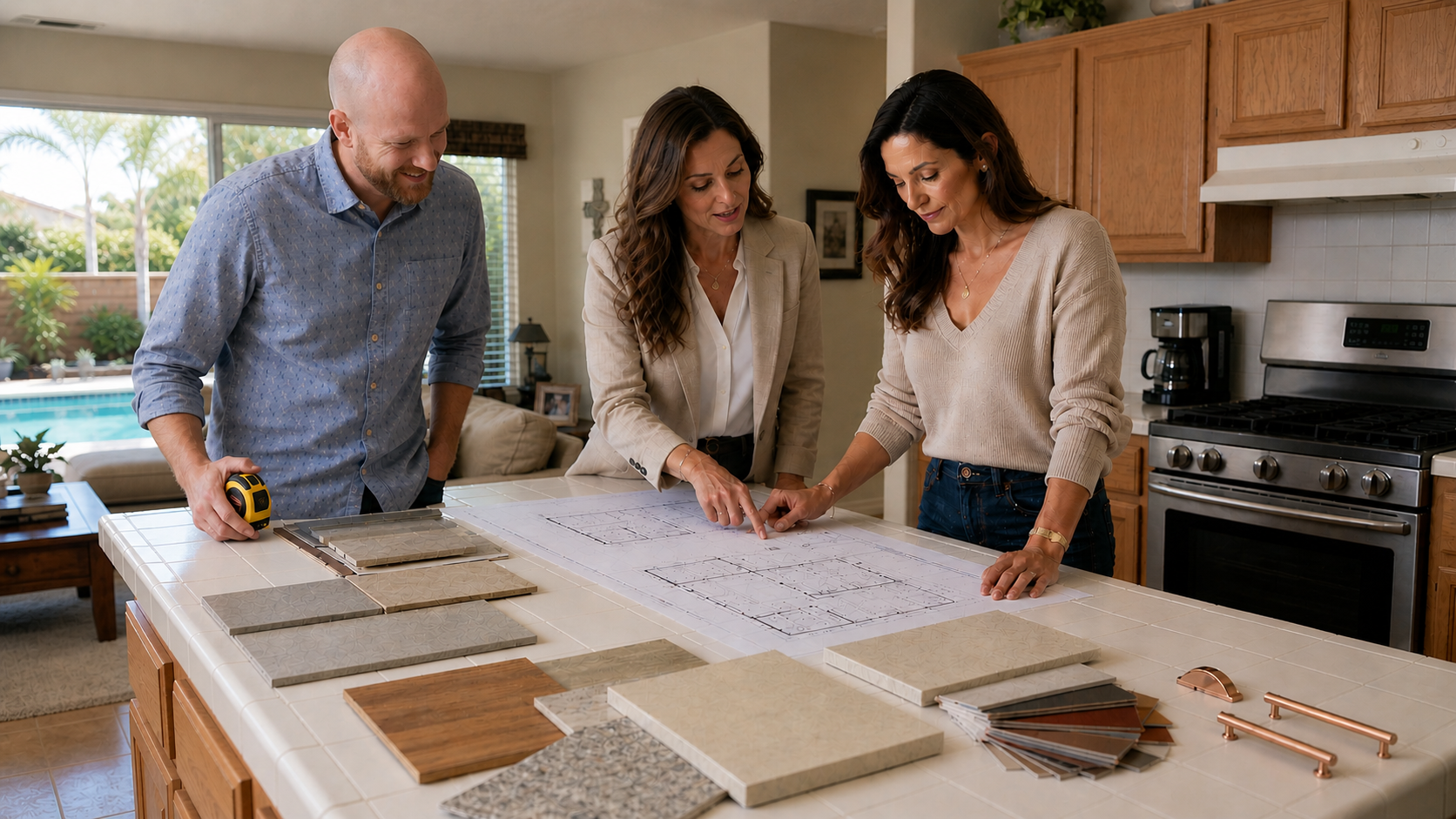
A pre-construction planning meeting for a Fullerton kitchen remodel, with Apex coordinating the homeowner, interior designer, plans, finish samples, and construction details before work begins.
At Apex, we like working with interior designers.
Not because it makes the project look better on Instagram.
Because it usually makes the entire remodel better.
For high-end residential projects in Fullerton, Brea, Yorba Linda, Anaheim Hills, and surrounding North Orange County communities, the best results rarely come from one person trying to make every decision alone. Strong remodels require planning, technical execution, design clarity, finish coordination, and constant communication.
That is where a good interior designer becomes extremely valuable.
A good designer helps the homeowner define the vision. A good contractor helps make that vision buildable. When both sides respect the other’s role, the client gets a smoother process and a better finished home.
That is the kind of project Apex wants to be part of.
Interior Designers Make Remodels Better
High-end remodeling is not just construction.
It’s hundreds of decisions stacked on top of each other.
Some are obvious:
Cabinet style
Countertops
Tile
Paint colors
Flooring
Lighting
Plumbing fixtures
Hardware
Furniture placement
Others are less obvious:
Cabinet clearances
Outlet locations
Lighting temperature
Tile layout
Grout color
Door swings
Shower niche placement
Trim profiles
Sightlines
Material transitions
How one room flows into the next
When those decisions are made casually or too late, the project suffers.
Interior designers help bring order to that process. They think about how the home should feel, how the rooms should connect, and how every finish decision supports the larger design.
That matters.
Especially on kitchens, bathrooms, additions, ADUs, and whole-home remodels where the finished result needs to feel intentional rather than pieced together.
Designers Help Clients Make Smarter Decisions Earlier
One of the biggest causes of remodeling stress is delayed decision-making.
Construction moves fast once the project is underway. If major design decisions are still unresolved during construction, the project can slow down, costs can change, and the client can feel pressured.
A strong interior designer helps homeowners make important decisions before the jobsite is active.
That may include:
Finish direction
Cabinet design
Fixture selections
Tile selections
Lighting plans
Flooring
Color palette
Hardware
Built-ins
Furniture considerations
Material compatibility
This early clarity helps everyone.
The homeowner feels less overwhelmed.
The designer protects the design intent.
The contractor has better information to plan, price, and schedule the work.
That is why Apex prefers projects where the design process is taken seriously before construction begins.
A Strong Design Plan Reduces Construction Friction
A remodel without design clarity can become a guessing game.
That is not good for the homeowner, the designer, or the contractor.
When selections are incomplete, drawings are unclear, or expectations are vague, the field team has to stop and ask questions that should have been resolved earlier.
That creates friction.
A well-developed design plan helps reduce that.
It gives the contractor a clearer target and helps avoid unnecessary backtracking.
For example, when the designer has already clarified tile layout, cabinet details, fixture selections, finish transitions, and lighting intent, the trades can execute with more precision.
This does not mean every project will be perfect or that no unexpected issues will come up. Remodeling existing homes always carries some unknowns.
But a strong designer-contractor partnership reduces avoidable problems.
That is the point.
Good Designers Protect the Finished Result
Homeowners do not always know how one decision will affect another.
That is normal. They should not have to.
A homeowner might like a tile, a light fixture, a flooring sample, and a cabinet color individually. But that does not mean those selections work together inside the actual home.
A good interior designer protects the homeowner from disconnected decisions.
They think about:
Scale
Proportion
Color temperature
Texture
Balance
Room-to-room continuity
How finishes look in natural light
How materials age
How the space will actually be used
That level of design oversight is especially important in premium remodels.
When a client is investing serious money into their home, the end result should not feel accidental. It should feel cohesive, personal, and well-resolved.
Apex values designers because they help protect that outcome.
Designer-Contractor Collaboration Improves Timelines
A good interior designer can also help protect the schedule.
Not by rushing the project.
By helping the project avoid preventable delays.
Selections with long lead times can slow down construction if they are chosen too late. Custom cabinetry, specialty tile, lighting, appliances, plumbing fixtures, and hardware all need planning.
When the designer and contractor communicate early, the team can identify:
What needs to be selected first
What has a long lead time
What details affect rough framing, plumbing, or electrical
What needs shop drawings or field verification
What decisions could impact schedule
What substitutions may or may not be acceptable
This is where a strong designer-contractor relationship pays off.
The contractor sees the construction sequence.
The designer sees the design intent.
Together, they help the homeowner avoid last-minute decision chaos.
Apex Respects the Designer’s Role
Some contractors treat designers like a complication.
Apex does not.
We understand that a skilled designer brings real value to the project. Designers are not just picking pretty finishes. On high-end residential remodels, they often help shape the entire client experience.
A good designer may help with:
Space planning
Finish specifications
Cabinetry details
Lighting concepts
Material coordination
Fixture selections
Furniture planning
Client communication
Design documentation
Visual continuity
Apex’s role is different.
Our job is to help bring the design into the real world through planning, construction knowledge, trade coordination, scheduling, jobsite control, and quality execution.
When those roles are respected, projects run better.
The Best Projects Are Built on Clear Lanes
Great designer-contractor collaboration does not mean everyone does everything.
It means the lanes are clear.
The designer leads the design vision.
The contractor leads construction execution.
The homeowner makes informed decisions with the right guidance from both sides.
That structure matters because confusion creates delays.
Apex works best when communication is direct and responsibilities are clearly defined.
Great designer-contractor collaboration does not mean everyone does everything.
It means the lanes are clear.
Finish Direction
The designer leads the overall design vision, material direction, and finish selections.
The contractor confirms buildability, construction sequencing, and installation requirements.
Cabinet Details
The designer develops the cabinet layout, style direction, and design intent.
The contractor coordinates field conditions, measurements, installation details, and trade requirements.
Lighting
The designer shapes fixture style, placement intent, and the overall lighting feel.
The contractor coordinates electrical layout, switching, rough-in, code-related requirements, and installation.
Tile Layout
The designer specifies the tile material, pattern, layout direction, grout color, and visual details.
The contractor coordinates substrate preparation, waterproofing, layout execution, and installation quality.
Schedule
The designer helps support timely finish selections and decision-making.
The contractor manages trade sequencing, construction flow, jobsite access, and schedule communication.
Budget
The designer helps align selections with the homeowner’s expectations and design goals.
The contractor prices labor, materials, trade work, construction scope, and any field-related changes.
This kind of clarity protects the client.
It also protects the relationship between designer and contractor.
Why This Matters for Homeowners
If you are a homeowner planning a high-end remodel, the relationship between your designer and contractor matters more than you may realize.
When that relationship is weak, you may experience:
Conflicting advice
Delayed answers
Unclear pricing
Last-minute decisions
Frustration between the field and design team
A finished result that misses the original design intent
When that relationship is strong, the experience is usually more organized.
You get better planning, better communication, better execution, and a more cohesive final result.
That is why Apex welcomes working with interior designers.
A good designer makes the project better for everyone involved.
Why This Matters for Interior Designers
Apex also understands what designers need from a contractor.
Designers need a builder who respects the work, protects the details, communicates clearly, and does not dismiss design intent in the field.
We know that when a designer brings us into a project, their reputation is connected to the outcome.
That matters to us.
Apex aims to be the kind of contractor designers feel comfortable recommending because we care about:
Clean jobsites
Clear communication
High-quality trade work
Respect for design details
Realistic planning
Professional client interaction
Follow-through
Protecting the finished product
We are not trying to take over the designer’s role.
We are there to execute the work properly and help the project succeed.
The Apex Fit
Apex is not a mass-market remodeling company.
We are a boutique residential contractor serving homeowners in Fullerton, Brea, Yorba Linda, Anaheim Hills, and nearby North Orange County communities.
We are a strong fit for projects where the client values:
A thoughtful process
Strong planning
Clean construction
Direct communication
Premium execution
Respect for design
A more controlled remodeling experience
We are also a strong fit for interior designers who want a contractor who understands that details matter.
The best remodels are not built by accident.
They are planned, coordinated, and executed by people who respect the work.
That is why Apex loves working with interior designers.
FAQ’s
Why should a homeowner hire both an interior designer and a contractor?
An interior designer helps shape the vision, selections, layout, materials, and overall feel of the home. A contractor manages construction, trade coordination, scheduling, jobsite protection, and execution.
For high-end remodels, both roles are important.
Does Apex work directly with interior designers?
Yes. Apex is well-suited for projects where an interior designer is already involved or where a homeowner plans to bring one in before construction.
Can Apex recommend an interior designer?
Yes. Apex may be able to suggest designer partners depending on the project type, style vision, location, and scope. Selecting and interior designer is like picking your wedding photographer, you pick them based on their style, not the other way around.
Does working with a designer make a remodel more expensive?
A designer is an additional professional service, but strong design planning can help reduce costly confusion, rushed decisions, and disconnected finish choices.
For premium remodels, a designer often helps protect the quality of the finished result.
What types of projects benefit most from a designer?
Designer involvement is especially valuable for:
High-end kitchen remodels
Whole-home remodels
Room additions
Projects with complex finish selections
Homes where the client wants a cohesive, elevated look
When should an interior designer be brought into the project?
Ideally, early.
The best time is before construction pricing is finalized and before major design decisions are locked in. Early collaboration helps the designer and contractor identify scope, selections, lead times, and construction implications.
Interior Designers: Looking for a Contractor Who Respects the Design?
Apex partners well with interior designers who care about detail, communication, and high-quality residential remodeling.
If you are designing a kitchen, bathroom, addition, ADU, or whole-home remodel in Fullerton, Brea, Yorba Linda, Anaheim Hills, or nearby North Orange County, Apex can help bring the work to life with clean execution and professional coordination.