

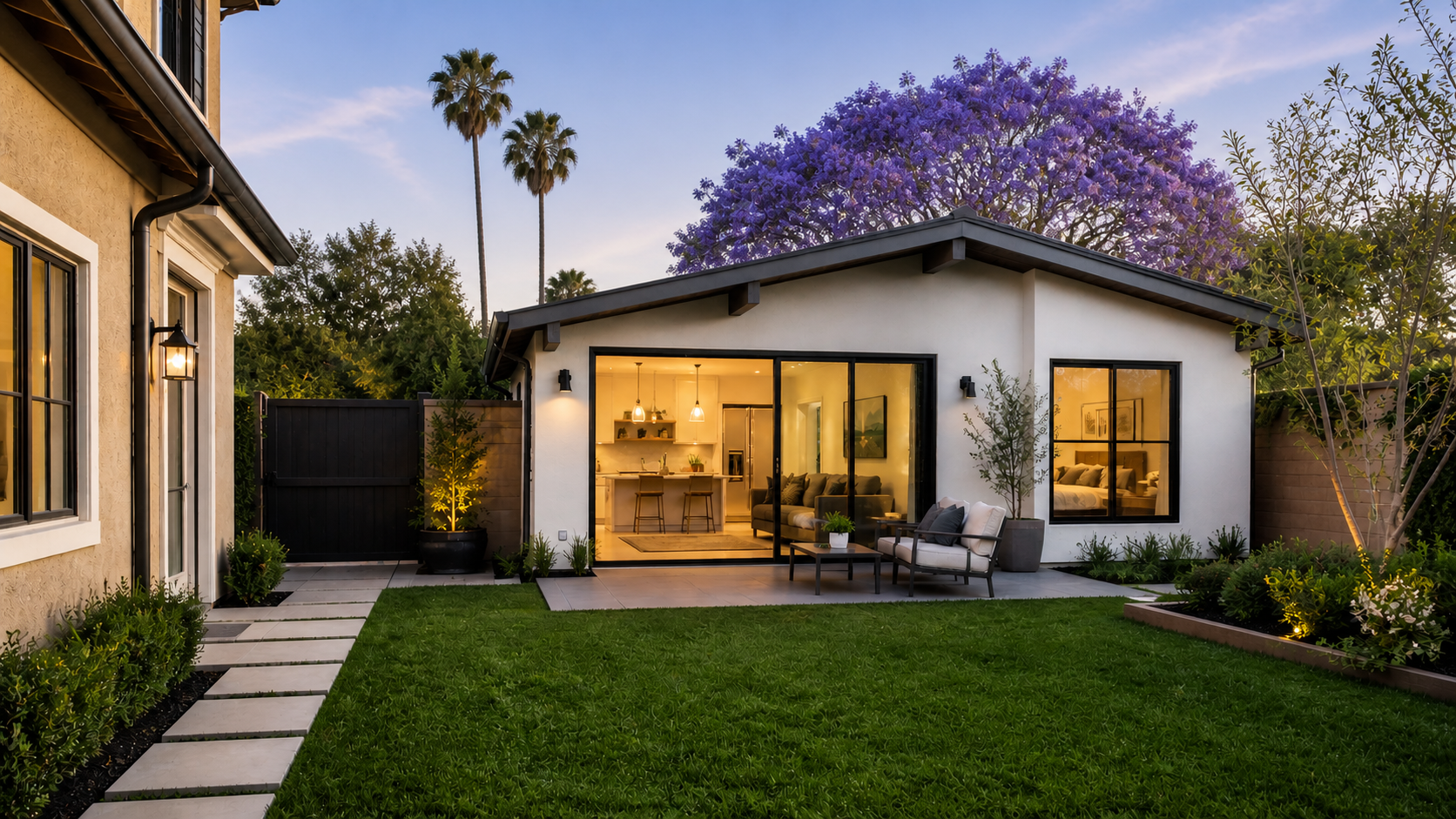
A custom backyard ADU in a refined North Orange County setting, designed to feel connected to the main home while providing private, flexible living space for family and guests.
Building an ADU sounds simple from the outside.
You have extra space. You want a small home in the backyard. Maybe it is for a parent, an adult child, guests, or long-term flexibility. The idea makes sense.
The problem is that an ADU is not just a “small remodel.”
It is a complete residential construction project with planning, design coordination, city requirements, utilities, site access, structural work, finish selections, inspections, and daily jobsite management. If those pieces are not handled correctly before construction starts, the project can turn into a long, expensive, frustrating mess.
For homeowners in Fullerton and North Orange County, the right ADU builder should do more than give you a price. They should help you understand the process, identify risks early, and guide the project from concept to completion with clear communication.
The Reality Check: Most Homeowners Start Too Late in the Process
A lot of homeowners make the same mistake.
They start by asking, “How much does an ADU cost?”
That is understandable, but it is not the best first question.
A better question is:
“What has to be solved before we know what this ADU should cost?”
That is where the real project begins.
Before a reliable budget can be built, several things need to be reviewed:
Property layout
Access to the backyard
Existing utilities
Drainage
Electrical capacity
Sewer location
Design requirements
City planning requirements
Structural needs
Finish level
Intended use of the ADU
Site constraints
Historic-zone or neighborhood considerations, if applicable
A basic garage conversion, a detached backyard ADU, and a high-end custom ADU for aging parents are not the same project. They should not be priced or planned the same way.
Why ADUs in Fullerton and North Orange County Require Careful Planning
Fullerton and surrounding North Orange County cities have older neighborhoods, varied lot sizes, mature landscaping, existing garages, tight side yards, slopes, drainage challenges, and homes built under different eras of construction.
That matters.
An ADU may look straightforward on paper, but the actual site conditions can change the entire construction approach.
For example:
A narrow driveway may limit equipment access.
Mature trees may affect layout and trenching.
Existing utilities may need upgrades or rerouting.
An older garage may not be structurally suitable for conversion.
A historic or character neighborhood may require more thoughtful exterior design.
A backyard with poor drainage may need correction before construction.
This is why pre-construction planning is not optional. It is where the project is either set up properly or quietly set up to fail.
What a Good ADU Builder Should Help You Figure Out First
Before you commit to construction, your builder should help you work through practical questions.
1. Who Is the ADU Really For?
An ADU for rental income is different from an ADU for your aging parent.
An ADU for an adult child is different from a guest house.
An ADU for future resale flexibility is different from one designed for daily multigenerational living.
The intended use affects the layout, privacy, accessibility, storage, parking strategy, finishes, laundry, outdoor space, and connection to the main home.
For example, if the ADU is for aging parents, you may want to think about:
Fewer steps
Wider clearances
Safer bathroom layout
Better lighting
Easy access from the main house
More storage than a typical rental unit
Quiet HVAC performance
Durable, low-maintenance finishes
Those decisions should happen early, not after framing starts.
2. Is the Site Actually Ready for an ADU?
A good ADU builder should not just look at the open space in the backyard and say, “Yes, we can build there.”
They should evaluate what it will take to build there.
That includes:
Access for demolition and construction
Utility routing
Soil and drainage concerns
Existing hardscape
Fence and gate access
Neighbor proximity
Material staging
Protection of the existing home
Noise and dust control
How the project will affect daily life while you live there
This is especially important for premium occupied-home projects. The construction experience matters, not just the finished structure.
3. What Level of Finish Matches the Main Property?
A cheap ADU can hurt the feel of a high-end property.
If your main home has quality finishes, mature landscaping, and a refined design language, the ADU should feel intentional. It does not need to be extravagant, but it should not feel like an afterthought.
A premium ADU should consider:
Exterior materials that complement the main home
Window and door proportions
Interior ceiling height and natural light
Cabinetry quality
Tile and flooring durability
Appliance package
Bathroom layout
Storage
Lighting
Sound control
Privacy between the main home and ADU
This is where a boutique contractor’s approach matters. The goal is not just to build square footage. The goal is to build something that belongs on the property.
The Biggest ADU Mistakes Homeowners Should Avoid
Mistake 1: Hiring Based on the Lowest Number
The cheapest ADU bid is rarely the safest number.
A low number may leave out important scope, assume basic finishes, ignore site complications, or fail to include enough project management. That does not mean every expensive bid is good. It means the number only matters if the scope behind it is clear.
For a serious ADU project, you need to understand:
What is included
What is excluded
What is assumed
What could change
Who is coordinating plans and trades
How selections are handled
How communication will work
How schedule will be managed
A vague bid creates vague expectations. Vague expectations create conflict.
Mistake 2: Designing Without Construction Input
A beautiful plan is not the same as a buildable plan.
Architects and designers are important, but the construction side needs to be involved early. Otherwise, homeowners can end up with a design that looks good but creates avoidable cost, schedule, or buildability problems.
Early contractor input can help identify:
Expensive structural choices
Utility conflicts
Difficult access issues
Overcomplicated rooflines
Inefficient layouts
Costly finish decisions
Scope gaps between drawings and real construction
The best projects usually happen when the homeowner, designer, architect, engineer, and contractor are aligned before construction begins.
Mistake 3: Underestimating Jobsite Management
An ADU is often built while the homeowner still lives in the main house.
That means jobsite management matters every day.
You need a contractor who thinks about:
Where materials will be stored
How workers access the site
How dust and debris are controlled
How the main home is protected
How neighbors are affected
How often you will receive updates
How inspections are coordinated
How trades are sequenced
A clean, organized project is not just about appearances. It usually reflects better planning and better control.
Mistake 4: Waiting Too Long to Make Finish Decisions
Finish selections can delay an ADU fast.
Cabinets, tile, plumbing fixtures, lighting, flooring, windows, doors, appliances, and hardware all affect schedule. If decisions are made too late, the job can stall while everyone waits for materials.
For a smoother project, selections should be handled before they become urgent.
That means creating a clear pre-construction plan for:
Design direction
Finish level
Allowances
Product lead times
Ordering schedule
Submittal approvals
Change-order process
Premium projects require fewer surprises, not more last-minute decisions.
How Apex Approaches ADU Projects Differently
Apex Construction & Restoration Inc. is not built around volume.
We limit the number of projects we take on so each client gets better attention, cleaner execution, and stronger communication. That matters on ADU projects because there are a lot of moving parts.
For custom ADUs in Fullerton and North Orange County, Apex focuses on:
Heavy pre-construction planning
Clear scope development
Coordination with architects, engineers, designers, and city officials
Realistic conversations about budget and feasibility
Clean, organized jobsites
Strong trade sequencing
Direct communication
High-quality finish execution
Respect for occupied homes and established neighborhoods
The goal is simple: help homeowners make informed decisions before the project starts, then manage construction with discipline once it begins.
An ADU is not just an extra structure. It may become a home for your parent, a place for your child, a long-term asset, or a key part of your family’s future. That deserves more than a rushed estimate and a loose plan.
When Should You Contact an ADU Builder?
The best time to contact a builder is before the design is fully locked in.
That does not mean you need every answer. It means you should have the right people involved early enough to prevent expensive mistakes.
You should consider speaking with an ADU builder if:
You are deciding between an addition and an ADU
You want to house aging parents
You are considering a detached backyard unit
You want to convert a garage
You are trying to understand feasibility
You already have plans but want construction input
You want a premium ADU that matches the quality of your home
The earlier the construction realities are reviewed, the better the final outcome usually is.
Final Word
A successful ADU project is not defined by how fast someone gives you a number.
It is defined by how well the project is planned before construction begins.
If you are considering a custom ADU in Fullerton, Yorba Linda, Brea, Placentia, Orange, Anaheim, or nearby North Orange County communities, Apex can help you evaluate the project clearly and build it with the level of care your home deserves.
Thinking about an ADU? Contact Apex Construction & Restoration Inc. to start a serious conversation about feasibility, planning, and next steps.